

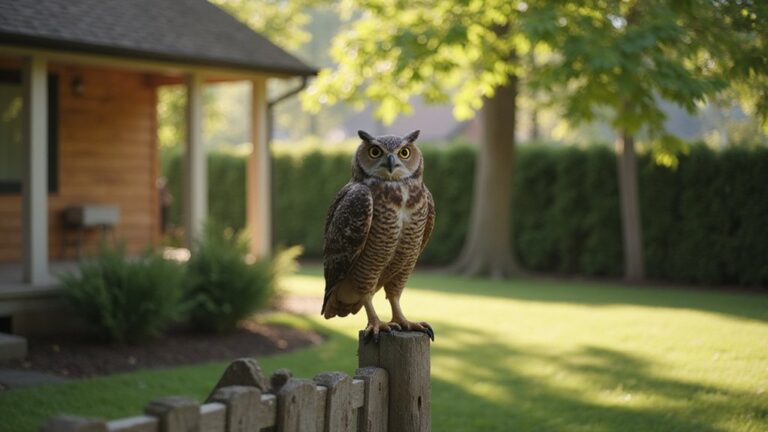
If you’re trying to keep birds away from your yard or garden, owl decoys might seem like a good option. They can scare birds initially, especially when placed high up near problem spots.
But their effectiveness usually only lasts a few days. Birds quickly catch on, so you’ll need to switch things up and use additional tactics for lasting control.
Keep reading to see what really works.
Why Do Fake Owls Scare Any Birds at All?
Fake owls scare birds primarily because they exploit their innate predator recognition. Even without movement or sound, a decoy’s shape, eye pattern, and posture resemble those of real raptors, triggering a bird’s survival instincts. Birds rely heavily on visual cues to identify threats, so a realistic owl silhouette can be enough to activate an alarm response. When a bird perceives the decoy as a predator, it may sound an alarm or quickly fly away. This reaction is hardwired into their brains and not learned through experience, especially in species like pigeons, starlings, and sparrows. Similar to how squirrel baffles block access by creating an insurmountable physical obstacle, the decoy’s effectiveness peaks when it closely resembles a perched raptor, convincing birds at a quick glance. However, because the decoy does not move or threaten, the fear response diminishes over time. For those dealing with carpenter bees, similar principles apply when using top bee traps reviewed for optimal placement.
What Does the Research Actually Say About Owl Decoys?
Research indicates that owl decoys are most effective as a short-term scare tactic rather than a permanent solution. Static decoys, which don’t move, tend to lose their effectiveness quickly because birds quickly habituate to them. For example, a study from Linfield University found that while an owl decoy could deter birds temporarily, its impact diminished within a few days as the birds became accustomed to it. Movement significantly boosts their effectiveness. In a University of Nebraska study, animated decoys that incorporated motion reduced bird damage by 81%. This demonstrates that movement plays a more critical role than shape or static appearance alone. Just as the effectiveness of mosquito dunks depends on water conditions and exposure, a decoy’s success relies on environmental variables and regular repositioning. To prolong their deterrent effect, you may need to regularly reposition the decoy or add sound elements to prevent birds from becoming familiar with it. For squirrels, habituation to visual threats occurs even faster than with birds, meaning a static owl decoy loses its scare value within a few days unless moved frequently. Overall, the evidence shows owl decoys work best when used temporarily, as part of a broader strategy, rather than as a one-time, permanent fix. For persistent predators like coyotes, however, comparing live trap options reveals that physical capture methods offer a more reliable long-term solution than visual scares alone.

Why Choose Our Bird Deterrent Garden Protectors: The horned owl scarecrow scares birds away from fruit trees or vine, squirrels, pigeons, rabbits, seagulls, varmints, raccoons and small mammal etc. Especially big yellow bright eyes and realistic physique to frighten birds, Keep the annoying visitors out of your garden, backyard, patio, and deck

SCARE BIRDS AWAY - Ultimate eco friendly bird and rodent repellent which uses the sun for 24 hours of continuous operation eliminating the need for batteries and manual charging.
Which Bird Species Actually Avoid an Owl Decoy?
Bird species that tend to avoid an owl decoy are generally those that see it as a credible threat. Small songbirds like chickadees and finches are often deterred initially, but their response varies by species and the environment. Chickadees show stronger avoidance than nuthatches, especially in open habitats where the decoy is more visible and perceived as a real predator. Conversely, crows, pigeons, and urban-adapted birds like gulls typically ignore the decoy after brief exposure, often due to their previous experience with predators or their accustomedness to human-made objects. For alternative pest control, a reliable option is Thermacell refills which provide continuous bug defense without relying on visual predator mimicry. Prey species such as sparrows and finches tend to stay away longer, especially when they perceive the threat as genuine. In contrast, birds like blue jays may even perch on the decoy or approach it cautiously. Factors like habitat and the bird’s level of vulnerability influence their reactions—birds in open, exposed areas tend to be more cautious, while those in cluttered or urban settings often habituate quickly. For securing your coop perimeter against persistent birds, consider using durable fence posts to support physical barriers that complement the decoy. Expect habituation to occur over time; most species will cease to respond if the decoy remains unmoving and ineffective as a deterrent. For potted plants, a chicken wire option can also serve as a simple physical barrier to protect seedlings from scratching birds.
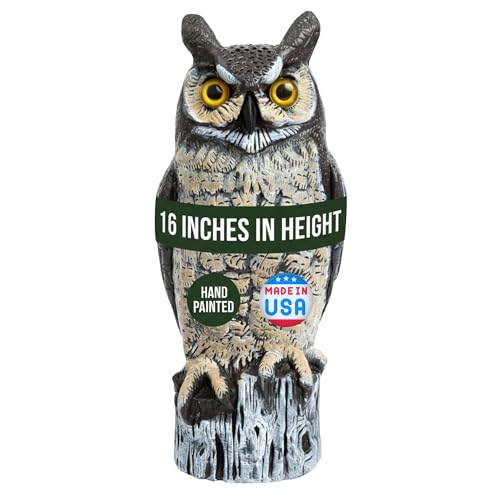
Lifelike Hand-Painted Detail - This owl statue features a hand-painted multi-color finish and realistic texture modeled after a Great Horned Owl commonly found in many North American regions, creating a lifelike fake owl that blends naturally into outdoor spaces.

Bird Repellent Garden Protectors: 2 pack horned owl statue set keep pests and birds away. Environmentally friendly and wildlife friendly, get rid of birds and pests humanely without harming them. Measures: each approx.5 inch(L) x 5 inch(W) x 10.6 inch(H). Please note that this owl is for outdoor decoration, which can't be ensure to be effective for all birds
Does Where You Place the Owl Decoy Make a Difference?
Placing your owl decoy at the right height is crucial for effectiveness. Aim to mount it 6 to 8 feet above ground on roofs, poles, or tree branches. Birds tend to scan from above, so a decoy positioned low or on flat ground looks suspicious and can lose its scare factor. Elevating the decoy makes it appear more life-like and threatening to problem birds. Position the decoy near a squirrel baffle can further prevent rodents from climbing to gain access to the area. For additional protection, a pond netting system can also keep debris and larger pests away from the water feature.
Position the decoy within 10 to 15 feet of the trouble spot, ensuring it faces likely approach routes. Use natural perches such as tree trunks or fence posts for added realism, avoiding bare or exposed surfaces. Always face the decoy towards open landing zones, never away from the target area, so that its eyes direct attention where birds might land.
To maintain its threat, rotate the decoy’s position, height, and orientation every 2 to 5 days. Keeping it static makes birds less wary over time. Moving the decoy mimics a real predator’s unpredictable behavior, boosting its deterrent effect. Avoid hiding the decoy behind obstacles or setting it with poor eyesight alignment, as that can diminish its ability to scare away birds altogether.
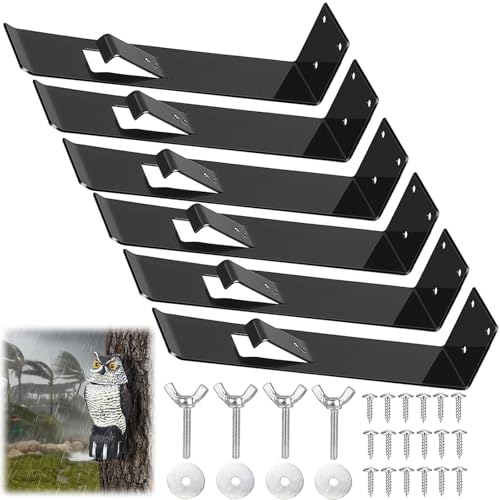
EXCELLENT TECHNOLOGY: Owl Mounting Bracket crafted from solid steel with a sleek finish, which is firm and not easy to bend. Quality black protective coating, build to resist daily scratches, corrosion and tarnishing

【Package Included】NOTE: NO fake owl decoy, ONLY ground bracket. The ground stake mount stand kit includes mount stand with 5 prongs base and a round platform and 10 pairs hook and loop fastener with self adhesive. This fake owl decoy ground bracket can ready to stand guard and ward off unwanted visitors

EXCELLENT TECHNOLOGY: Owl Mounting Bracket crafted from solid steel with a sleek finish, which is firm and not easy to bend. Quality black protective coating, build to resist daily scratches, corrosion and tarnishing
How Fast Do Birds Learn the Owl Decoy Isn’t Real?
Most birds, like crows and sparrows, learn that an owl decoy isn’t real within a day or two of repeated exposure. They quickly notice that the decoy remains stationary and doesn’t react or move, which signals it’s not a threat. This visual recognition causes habituation—the process of becoming accustomed and losing fear—especially when the decoy provides no live movement or danger cues. The speed at which birds adapt depends on how often they see the decoy in the same spot. Multiple exposures in a short period reinforce the idea that there is no danger, speeding up the learning process. Without any movement or behavioral cues indicating threat, the birds’ fear diminishes rapidly. Expect only a few days of effectiveness from a static owl decoy, as birds tend to dismiss it once they recognize it’s not a real predator. For similar reasons, wasp spray can kill many pests but should not be used for snake control due to safety risks.
How to Make a Fake Owl Last Longer Than a Few Days
To make a fake owl last longer than a few days, focus on material durability and strategic positioning. Use a weatherproof plastic model with UV-resistant coatings and fade-resistant paint to prevent cracking and sun damage. Regularly rotate the decoy every few days to delay birds’ habituation and maintain effectiveness. Placements should also vary—move the owl to different heights or locations periodically to keep it convincing. For example, the decoy’s rotating head driven by natural wind helps simulate hunting behavior, enhancing its effectiveness as a predator deterrent. Clean the decoy frequently, as dirt reduces realism and can accelerate wear. Expect paint to fade after about a year, so seasonal replacements help keep the deterrent convincing and effective. These practices extend the usefulness of your fake owl significantly beyond just a few days. For severe roach infestations, a bug bomb may offer a more immediate eradication solution than any decoy. To complement your owl, consider combining it with a fruit fly trap to address indoor pest issues that a static decoy cannot solve. When installing the fake owl, using t posts as a mounting base can provide a sturdy, adjustable support that also mimics the perch of a real predator.

【Great Value】Our owl set design includes 3 decoys for the price of one, providing a cost-effective solution to protect your property from bird damage. If you're looking to try using owl decoys to solve your bird problems, our set is the best choice. With two extra owls included, you can cover more areas and increase the effectiveness of the deterrent.

Hand-painted owl statue with lifelike feather texture, bright expressive eyes, and a true-to-life silhouette recreates the look of a real owl, a bird's natural predator. From a distance it reads as a living owl, making a natural, realistic garden accent that blends into porches, patios, decks, gardens, and yards.

【Great Value】Our set of 2 owl offers an affordable and effective solution to protect your property from bird damage. With two owl included, you can cover more areas and increase the effectiveness.
When to Use an Owl Decoy: and When to Skip It
Owl decoys are effective for quick, temporary scares but should not be your primary long-term solution. Use one when birds first start appearing at feeders, ledges, or garden beds, especially during seasonal migration when unfamiliar species pass through. The goal is to create immediate avoidance, which is strongest right after installation. However, this effect often diminishes within days as birds become habituated. If birds are already causing consistent nest disruption or heavy feeding, relying solely on an owl decoy won’t be effective. In such cases, it’s better to use the decoy as a short-term tool alongside other deterrents. Avoid depending on an owl decoy to control persistent pest problems over the long run. For a similar approach to managing skunks, consider best skunk baits for trapping when other methods fail.

Realistic Bird Deterrent Garden Protectors: The Great Horned Owl scarecrow is extremely lifelike. Especially big yellow bright eyes and realistic physique to frighten birds, Keep the annoying visitors out of your garden, backyard, patio, and deck

Rotating Head Owls Sculpture. Our owl sculpture’s head can sway along the breeze. Connected by a flexible spring, the head of this owl decoy sculpture can be adjusted to your desired position. Its body can be filled with sand, or pebbles to weight up for stability and a rod can be attached to the bottom for ease of securing to structures or fixtures.

Hand Painted Garden Decoration - An amazing ornamental garden owl. Every single Owlsome solar owl is painted by hands in order to get it more realistic. The life-like owl can bring a lot of joy to your garden.